
RESEARCH CATALOG
MOTS-c
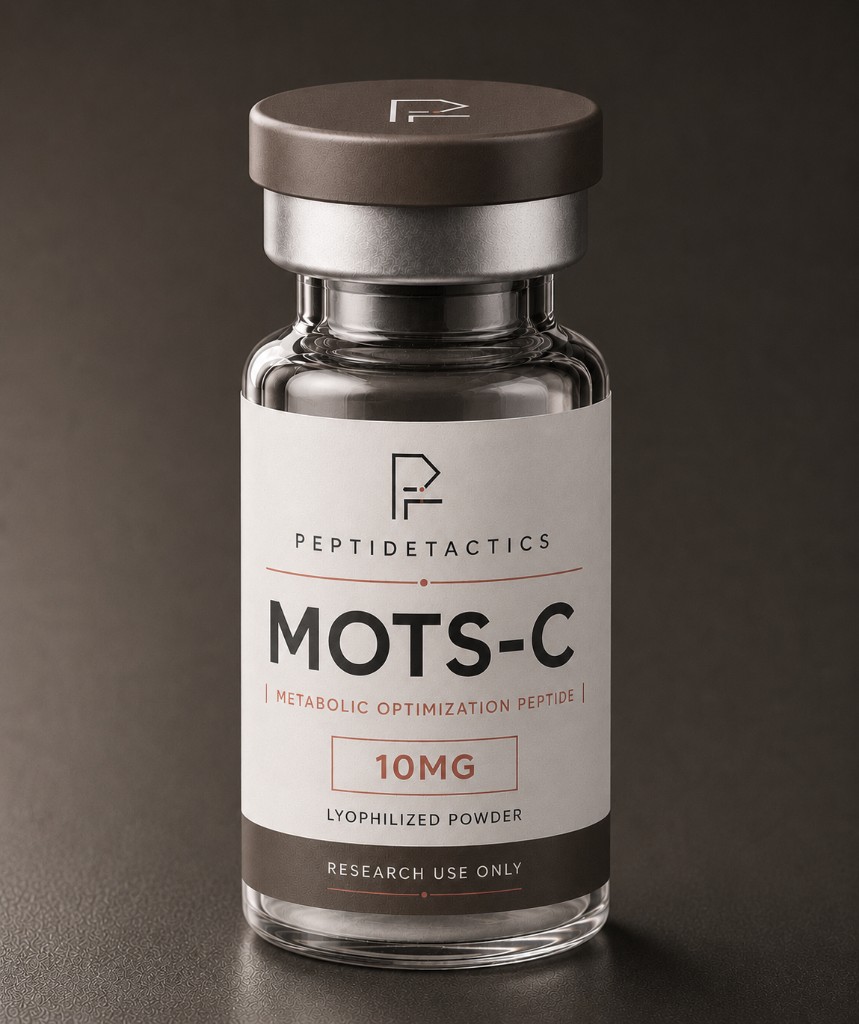
MOTS-C is listed in the Peptide Tactics catalog and available to order for research use in India, supplied as a 10 mg lyophilized vial. It is also written MOTS-c, MOTS C or MOTSc. Because the sequence carries two methionine residues, oxidation is a specific analytical consideration for this compound, and the sections below cover that alongside listed pricing, reference data and documentation.
MOTS-c is a 16-residue mitochondrial-derived peptide. It is unusual among the peptides in this catalog because it is encoded within the mitochondrial genome rather than the nuclear genome, in an alternative open reading frame inside the 12S ribosomal RNA gene.
Enquiries are completed over WhatsApp or email. Peptide Tactics provides information and distribution for qualified research use. See the research-use policy before ordering.
Also written as
MOTS C · MOTSc · MOTS-C · mitochondrial ORF of the 12S rRNA type-c
Compound identity
| Amino acid sequence | MRWQEMGYIFYPRKLR(PubChem CID 146675088) |
|---|---|
| Length | 16 residues(PubChem CID 146675088) |
| Molecular formula | C101H152N28O22S2(PubChem CID 146675088) |
| Molecular weight | 2174.6 g/mol(PubChem CID 146675088) |
| PubChem CID | 146675088(PubChem) |
| Genomic origin | Alternative open reading frame within the mitochondrial 12S rRNA gene (MT-RNR1)(PMID 25738459) |
| Catalog format | 10 mg • lyophilized powder(catalog information) |
Each row above is attributed to its source. Rows citing a database record are reference information about the molecule; rows marked catalog information describe this listing. Neither is a specification, an analytical result or a claim about any particular batch.
Research classification
Mitochondrial-derived peptide (MDP), encoded by an alternative open reading frame within the mitochondrial 12S rRNA gene. Studied in metabolic research literature (Lee et al., Cell Metabolism, 2015; PMID 25738459); those are findings reported in research models, not effects attributed to any supplied material. Not an approved medicine.
Chemical characteristics
- The sequence contains two methionine residues, which are susceptible to oxidation. Oxidised methionine adds 16 Da per residue and is a common cause of extra peaks in chromatograms and satellite masses in spectra.
- A single tryptophan and two tyrosine residues give the peptide useful ultraviolet absorbance around 280 nm, which is convenient for detection.
- Three arginine residues and one lysine make the peptide net-basic at neutral pH, which affects its retention behaviour and its charge-state envelope in electrospray ionisation.
Analytical methods
- Reversed-phase HPLC (RP-HPLC) is the method most commonly used to express the chromatographic purity of a synthetic peptide as a percentage of total peak area at a stated wavelength.
- Mass spectrometry (typically ESI-MS or MALDI-TOF) is used to confirm that the observed mass of the material is consistent with the expected mass of the intended sequence.
- Because purity figures are method-dependent, an analytical result is only interpretable alongside the method conditions and the batch it describes.
Both methods are covered in more detail in our guides to HPLC analysis of peptides and mass spectrometry for identity confirmation.
Stability and storage considerations
- Lyophilized peptides are generally supplied as a dry solid because the removal of water slows hydrolytic degradation pathways.
- Cold, dry, light-protected storage is the general handling expectation for lyophilized research peptides.
- Once a peptide is taken into solution, its stability profile changes and is influenced by solvent, pH, temperature and the number of freeze-thaw cycles.
- Storage and handling expectations for a specific batch should be taken from that batch's documentation rather than from general guidance.
See peptide stability and degradation for the chemistry behind these considerations.
What this page does not claim
- MOTS-c is a subject of published metabolic research. Peptide Tactics makes no claim about physiological effects, and nothing in this catalog is presented as a treatment or intervention.
- Reported masses vary slightly between sources depending on whether an average or monoisotopic mass is quoted and on counter-ion content in a given preparation.
Independent Analytical Documentation
Janoshik Analytical verification
Catalog products are independently verified through Janoshik Analytical. Certificates of analysis from that laboratory are issued per product and per batch — not as a single generic document for the whole catalog — so the report you receive describes the material you are ordering.
Should you require a Janoshik COA for MOTS-C, write to us on WhatsApp and we will provide the applicable report for that product.
We do not currently publish a full independent analytical report on this page for the MOTS-C listed here. That does not mean documentation is unavailable — it means the report is supplied on request for the batch being fulfilled, rather than attached permanently to a catalog listing that outlives any one batch.
If a report is a requirement for your work, ask before ordering. We will check what Janoshik or other documentation covers the current batch and tell you what it is. Where nothing exists for that batch, we will say so.
Reading the documentation matters as much as having it. Our guides on how to read a peptide certificate of analysis and what a purity figure does and does not mean cover what to look for, and our documentation page explains the request process.
Ordering MOTS-C in India
MOTS-C is ordered through the catalog and finalised over WhatsApp or email, so that any question about specification or documentation is settled before the order is placed rather than after it.
Immediate dispatch whenever couriers are operating. Orders from Bangalore are dispatched immediately whenever courier operations are open. Orders from elsewhere in India are dispatched as soon as couriers are operating.
Distribution is within India. Material is supplied for in-vitro research and analytical applications only, and we do not supply for human or veterinary use.
Frequently asked questions
- Can I buy MOTS-C in India from Peptide Tactics?
- Yes. MOTS-C is listed as a 10 mg lyophilized vial with the price shown on this page, available to order for research use within India. It is also written MOTS-c or MOTSc; these refer to the same compound and the same listing.
- What documentation can I request for MOTS-C?
- You can request whatever documentation exists for the batch being supplied, and we will tell you what that is before you order. Depending on the batch that may be a supplier certificate of analysis or an independent laboratory report. We do not hold a published independent analytical report for the MOTS-C currently listed and do not claim one. Where documentation does not exist, we say so rather than implying it does.
- How quickly are MOTS-C orders dispatched?
- Dispatch is immediate whenever courier services are operating. Bangalore orders take priority in the dispatch queue; orders from elsewhere in India go out as soon as couriers are running, and anything received outside courier hours is dispatched when they reopen. We do not quote a delivery date, because transit time is the courier's and not ours.
- Can you source a peptide that is not listed?
- Yes. Our catalog is what we currently hold, not the limit of what we can look into. Send the compound name, quantity and any specification that matters — salt form, purity threshold, documentation requirement — and we will investigate sourcing options and tell you what is possible, what it would cost and what documentation exists.
- Is MOTS-C intended for human use?
- No. Everything in this catalog is supplied for in-vitro research and analytical applications only, and not for human or veterinary use. We do not provide dosing, administration guidance or any therapeutic recommendation, and we cannot supply material for those purposes.
- What is MOTS-c?
- MOTS-c is a peptide of 16 amino acids (MRWQEMGYIFYPRKLR) encoded in an alternative reading frame within the mitochondrial 12S rRNA gene. It belongs to the small group of peptides described in the literature as mitochondrial-derived peptides.
- What is the molecular weight of MOTS-c?
- Public chemical database records give a molecular formula of C101H152N28O22S2 and a molecular weight of approximately 2174.6 g/mol.
- Why is methionine oxidation relevant to MOTS-c analysis?
- MOTS-c contains two methionine residues. Methionine can oxidise to the sulfoxide, adding approximately 16 Da per residue. This shows up as additional chromatographic peaks and as satellite masses in spectra, so it is worth accounting for when interpreting analytical data.
- What format is MOTS-c supplied in?
- The catalog entry is a 10 mg vial of lyophilized powder.
Sources
Can't Find the Compound You Need?
Our catalog lists what we currently hold, and it is not the full range of research materials we can look into. If you need a compound that is not listed, tell us what you are looking for and we will investigate sourcing options for it.
Useful things to include in your enquiry:
- The compound name, and any code or CAS number you have for it.
- Quantity per vial, and how many vials.
- Any specification that matters to your work — salt form, purity threshold, or the analytical method you need it reported against.
- Whether batch documentation or an independent analytical report is a requirement, so we can establish up front whether it is available.
We will tell you what we can source, what it would cost and what documentation exists. Where we cannot source something, or cannot establish its documentation, we will say so rather than take the order.
Sourcing enquiries are accepted for in-vitro research and analytical use only. We cannot supply material for human or veterinary use, and we do not advise on how any compound should be used.
Related compounds
BPC-157
Buy BPC-157 in India from Peptide Tactics. 10 mg research vial, listed pricing, verified sequence and molecular data, documentation on request.
View compound pageTB-500
Buy TB-500 in India from Peptide Tactics. 10 mg research vial with listed pricing, the Ac-LKKTETQ-OH reference data and an honest account of the name's ambiguity.
View compound pageFurther reading
- What are peptides? — A peptide is a chain of amino acids joined by amide bonds.
- Mass spectrometry and peptide characterisation — Chromatography tells you how many species are present.
- Peptide stability and degradation — Peptides degrade by a small number of well-characterised chemical routes.