
RESEARCH CATALOG
Bacteriostatic Water
Bacteriostatic water is listed in the Peptide Tactics catalog and available to order in India as a laboratory diluent, supplied as a 10 mL vial preserved with 0.9% benzyl alcohol. It is often searched as BAC water. It is not a peptide and is listed for laboratory reconstitution and dilution work; the sections below cover what the preservative does, when an unpreserved diluent is required instead, and how benzyl alcohol behaves in analytical methods.
Bacteriostatic water is sterile water containing benzyl alcohol as a bacteriostatic preservative. It is listed here as a laboratory diluent rather than as a peptide. The preservative is what distinguishes it from plain sterile water.
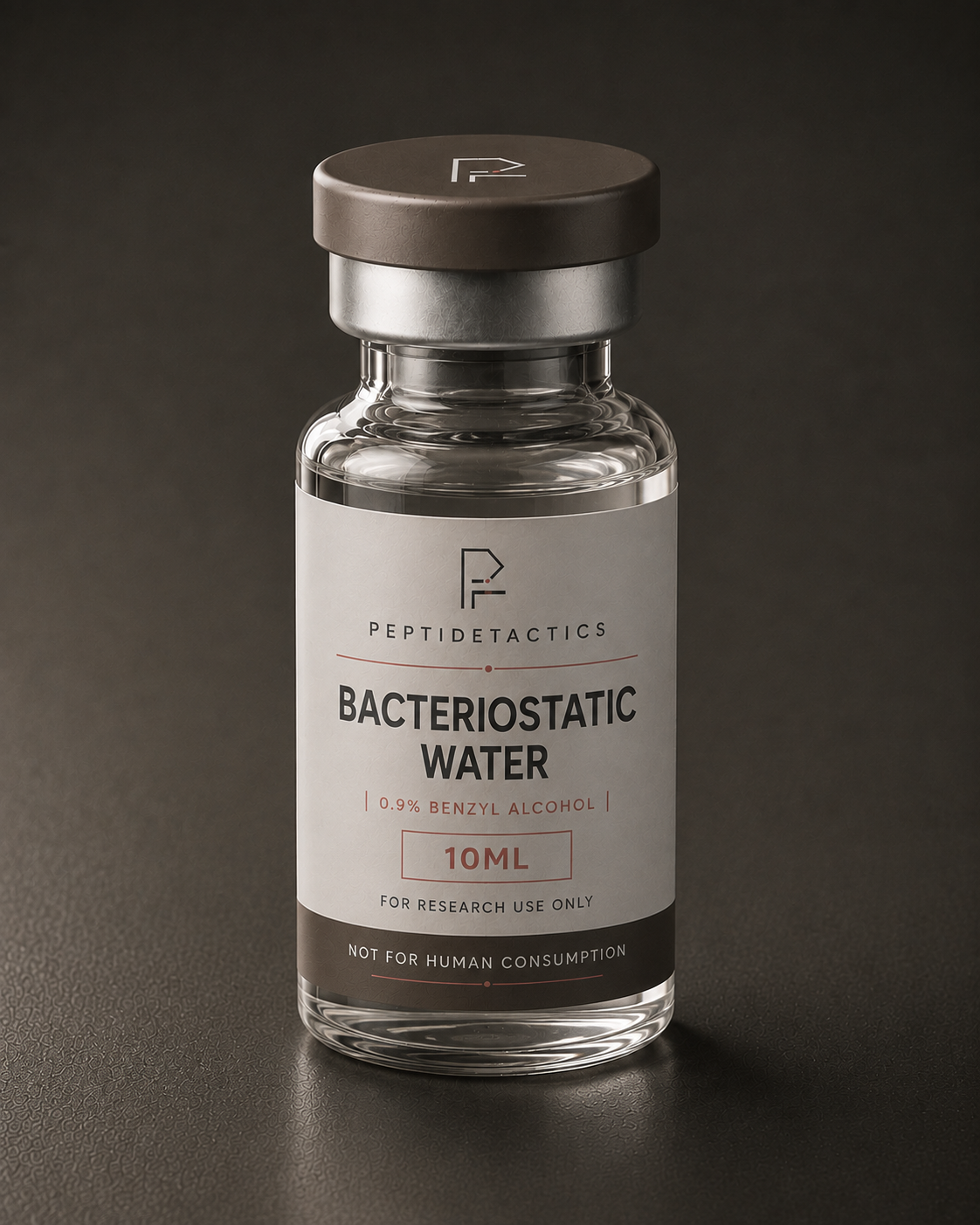
- Reusable vial
- 10 mL
- Multi-use until empty
Enquiries are completed over WhatsApp or email. Peptide Tactics provides information and distribution for qualified research use. See the research-use policy before ordering.
Also written as
BAC water · bacteriostatic water · preserved sterile water
Compound identity
| Volume | 10 mL(catalog information) |
|---|---|
| Preservative | 0.9% benzyl alcohol(catalog information) |
| Base | Sterile water(catalog information) |
| Presentation | Reusable multi-use vial(catalog information) |
| Catalog format | 10 mL • 0.9% benzyl alcohol(catalog information) |
The values above are catalog information describing this listing. They are not a specification, an analytical result or a claim about any particular batch.
Reusable Multi-Use Vial
Unlike typical single-use plastic containers, this Bacteriostatic Water comes in a reusable vial designed to be accessed repeatedly until the contents are depleted.
Research classification
Preserved aqueous diluent for laboratory use. Not presented for human or veterinary use.
Chemical characteristics
- Benzyl alcohol is recorded in PubChem as C7H8O with a molecular weight of 108.14 g/mol (CID 244). Its aromatic ring absorbs in the ultraviolet, which is the practical reason a preserved diluent is not neutral in every ultraviolet-detected method.
- Antimicrobial preservatives are not inert towards peptides. Benzyl alcohol in particular has been reported to promote aggregation in peptide formulations (PMID 35917158), which is a compatibility consideration when choosing a diluent for analytical work.
- Benzyl alcohol is bacteriostatic rather than bactericidal: it inhibits bacterial growth rather than sterilising a contaminated solution. A preserved diluent does not rescue material that has already been compromised.
- The preservative is what allows a multi-use presentation, which is the practical reason preserved diluents exist alongside single-use sterile water.
- Benzyl alcohol is not inert for every application. Some analytical and cell-based work requires an unpreserved diluent, so the choice of solvent should follow the requirements of the method being run.
Analytical methods
- Reversed-phase HPLC (RP-HPLC) is the method most commonly used to express the chromatographic purity of a synthetic peptide as a percentage of total peak area at a stated wavelength.
- Mass spectrometry (typically ESI-MS or MALDI-TOF) is used to confirm that the observed mass of the material is consistent with the expected mass of the intended sequence.
- Because purity figures are method-dependent, an analytical result is only interpretable alongside the method conditions and the batch it describes.
Both methods are covered in more detail in our guides to HPLC analysis of peptides and mass spectrometry for identity confirmation.
Stability and storage considerations
- Lyophilized peptides are generally supplied as a dry solid because the removal of water slows hydrolytic degradation pathways.
- Cold, dry, light-protected storage is the general handling expectation for lyophilized research peptides.
- Once a peptide is taken into solution, its stability profile changes and is influenced by solvent, pH, temperature and the number of freeze-thaw cycles.
- Storage and handling expectations for a specific batch should be taken from that batch's documentation rather than from general guidance.
See peptide stability and degradation for the chemistry behind these considerations.
What this page does not claim
- This listing is a laboratory diluent. Nothing on this page is guidance for preparing material for human or veterinary use, and no such use is supported.
- Solvent selection depends on the analytical or experimental method involved and should be determined by the researcher against the requirements of that method.
Independent Analytical Documentation
Janoshik Analytical verification
Catalog products are independently verified through Janoshik Analytical. Certificates of analysis from that laboratory are issued per product and per batch — not as a single generic document for the whole catalog — so the report you receive describes the material you are ordering.
Should you require a Janoshik COA for Bacteriostatic Water, write to us on WhatsApp and we will provide the applicable report for that product.
We do not currently publish a full independent analytical report on this page for the Bacteriostatic Water listed here. That does not mean documentation is unavailable — it means the report is supplied on request for the batch being fulfilled, rather than attached permanently to a catalog listing that outlives any one batch.
If a report is a requirement for your work, ask before ordering. We will check what Janoshik or other documentation covers the current batch and tell you what it is. Where nothing exists for that batch, we will say so.
Reading the documentation matters as much as having it. Our guides on how to read a peptide certificate of analysis and what a purity figure does and does not mean cover what to look for, and our documentation page explains the request process.
Ordering Bacteriostatic Water in India
Bacteriostatic Water is ordered through the catalog and finalised over WhatsApp or email, so that any question about specification or documentation is settled before the order is placed rather than after it.
Immediate dispatch whenever couriers are operating. Orders from Bangalore are dispatched immediately whenever courier operations are open. Orders from elsewhere in India are dispatched as soon as couriers are operating.
Distribution is within India. Material is supplied for in-vitro research and analytical applications only, and we do not supply for human or veterinary use.
Frequently asked questions
- Can I buy bacteriostatic water in India from Peptide Tactics?
- Yes. Bacteriostatic water is listed as a 10 mL vial preserved with 0.9% benzyl alcohol, with the price shown on this page, available to order in India as a laboratory diluent. It is often searched as BAC water.
- What documentation can I request for bacteriostatic water?
- You can ask what documentation accompanies the batch supplied, and we will tell you what exists before you order. Note that the volume and preservative concentration shown on this page are catalog information describing the listing; they are not analytical results, and we have not independently verified the concentration or the sterility of any batch.
- How quickly are orders dispatched?
- Dispatch is immediate whenever courier services are operating. Bangalore orders take priority in the dispatch queue; orders from elsewhere in India go out as soon as couriers are running, and anything received outside courier hours is dispatched when they reopen. We do not quote a delivery date, because transit time is the courier's and not ours.
- Can you source a laboratory material that is not listed?
- Yes. Our catalog is what we currently hold, not the limit of what we can look into. Send the compound name, quantity and any specification that matters — salt form, purity threshold, documentation requirement — and we will investigate sourcing options and tell you what is possible, what it would cost and what documentation exists.
- Is this intended for human use?
- No. Everything in this catalog is supplied for in-vitro research and analytical applications only, and not for human or veterinary use. We do not provide dosing, administration guidance or any therapeutic recommendation, and we cannot supply material for those purposes.
- What is bacteriostatic water?
- It is sterile water containing a bacteriostatic preservative — in this listing, 0.9% benzyl alcohol. The preservative inhibits bacterial growth, which is what allows a multi-use presentation.
- Is this supplied in a reusable vial?
- Yes. The catalog listing is a 10 mL reusable vial, so the contents can be accessed more than once until the vial is empty. That is a presentation detail of this listing, not a claim about sterility after opening, which depends on how the material is handled in the laboratory.
- How does bacteriostatic water differ from sterile water?
- Plain sterile water contains no preservative. Bacteriostatic water contains benzyl alcohol, which inhibits bacterial growth. Some analytical and cell-based methods specifically require an unpreserved diluent, so they are not interchangeable.
- Does the preservative affect analytical work?
- It can. Benzyl alcohol carries an aromatic ring and therefore absorbs in the ultraviolet region, and it is not inert in every assay format. Its presence should be accounted for when selecting a diluent for a given method, particularly for ultraviolet detection.
- What is the molecular weight of benzyl alcohol?
- PubChem records benzyl alcohol (CID 244) with a molecular formula of C7H8O and a molecular weight of 108.14 g/mol. That describes the preservative itself, not this listing, whose stated concentration is catalog information rather than a verified analytical result.
Sources
Can't Find the Compound You Need?
Our catalog lists what we currently hold, and it is not the full range of research materials we can look into. If you need a compound that is not listed, tell us what you are looking for and we will investigate sourcing options for it.
Useful things to include in your enquiry:
- The compound name, and any code or CAS number you have for it.
- Quantity per vial, and how many vials.
- Any specification that matters to your work — salt form, purity threshold, or the analytical method you need it reported against.
- Whether batch documentation or an independent analytical report is a requirement, so we can establish up front whether it is available.
We will tell you what we can source, what it would cost and what documentation exists. Where we cannot source something, or cannot establish its documentation, we will say so rather than take the order.
Sourcing enquiries are accepted for in-vitro research and analytical use only. We cannot supply material for human or veterinary use, and we do not advise on how any compound should be used.
Related compounds
BPC-157
Buy BPC-157 in India from Peptide Tactics. 10 mg research vial, listed pricing, verified sequence and molecular data, documentation on request.
View compound pageMOTS-c
Buy MOTS-C in India from Peptide Tactics. 10 mg research vial with listed pricing, 16-residue sequence, molecular data and oxidation notes. Research use only.
View compound pageFurther reading
- Lyophilized peptides explained — Almost every research peptide arrives as a lyophilized solid.
- Peptide stability and degradation — Peptides degrade by a small number of well-characterised chemical routes.